Senet · Rules
How to Play Senet
2 players · 15-30 min
Senet is a two-player race game played on a board of thirty squares. Each player tries to move all their pawns along a winding track and off the far end of the board before their opponent does.
A note on honesty: no complete ancient ruleset for Senet survives. The rules below are a widely used reconstruction, drawn chiefly from the work of Egyptologists Timothy Kendall and R. C. Bell, who pieced the game together from tomb paintings, inscriptions, and surviving boards. Different reconstructions disagree on details, so treat these as a faithful, playable interpretation rather than gospel.
The Objective
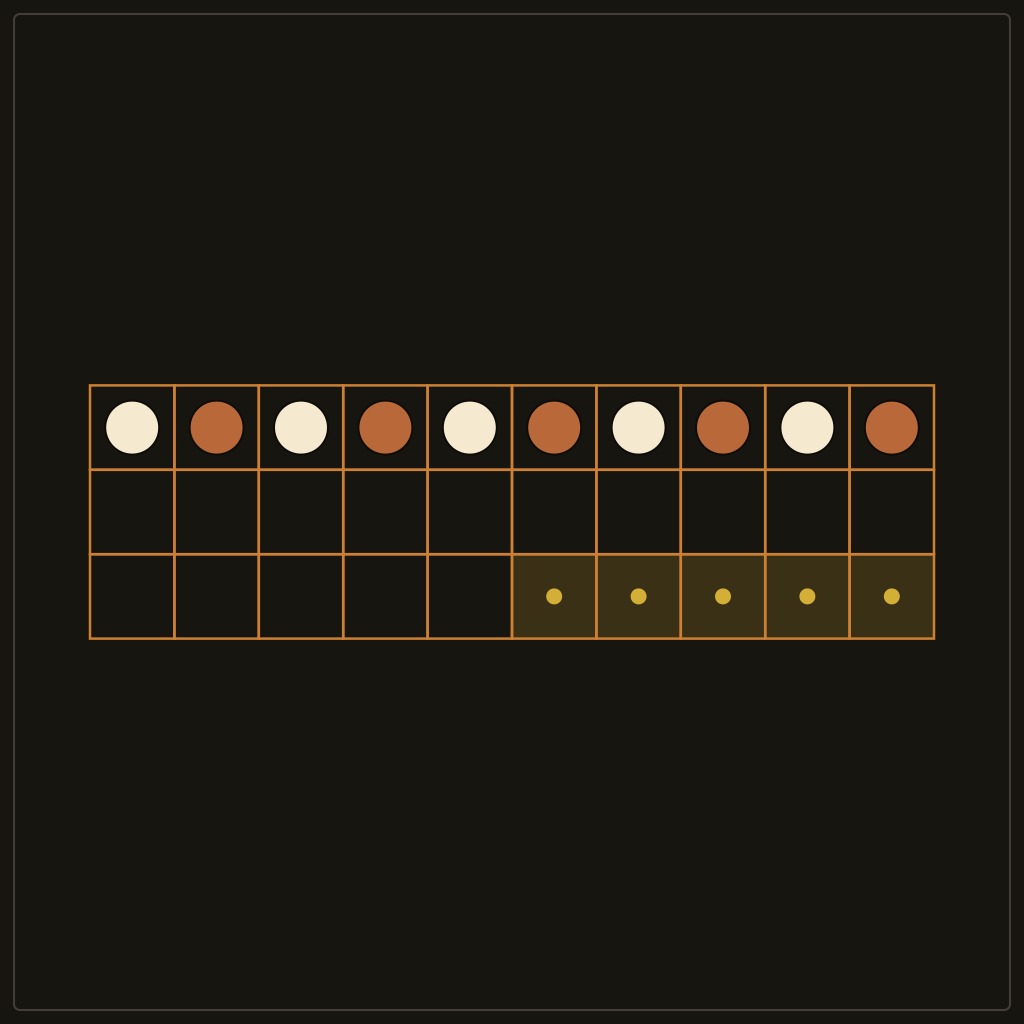
Be the first player to move all of your pawns across the 30-square board and bear them off the final edge. The track snakes in a boustrophedon (“as the ox plows”) path: left to right along the top row, right to left along the middle, then left to right along the bottom.
Setup
Use a board of 3 rows of 10 squares (30 total). Each player takes 5 pawns. Place them on the first ten squares in alternating order, so the two colors interlock along the opening row. Decide who moves first by a single throw of the sticks.
Throwsticks (Movement)
Senet uses four throwsticks, each flat with one marked (light) side and one blank (dark) side. There are no dice. On your turn, cast all four and count the marked faces showing upward:
- 1 mark up = move 1 (and throw again)
- 2 marks up = move 2
- 3 marks up = move 3
- 4 marks up = move 4 (and throw again)
- 0 marks up = move 5 (and throw again)
A throw of 1, 4, or 5 earns another turn. You must move a pawn if any legal move exists. You may not land on a square occupied by your own pawn. Landing on a square holding a single enemy pawn swaps the two pieces, sending the opponent back to where you came from. Two or more enemy pawns side by side are protected and block that square; three in a row cannot be passed at all.
Special Squares
Several of the final squares carry names and rules:
- Square 26, House of Happiness: a required stop that gives a bonus throw.
- Square 27, House of Water: a hazard. A pawn landing here is sent back (commonly to square 15, the House of Rebirth, or off the board to re-enter).
- Square 28, House of the Three Truths: exit only on a throw of 3.
- Square 29, House of Re-Atum: exit only on a throw of 2.
- Square 30, House of Horus: exit only on a throw of 1.
Winning
Once a pawn reaches the end of the track, it can be borne off the board with an exact or sufficient throw, subject to the exit conditions of squares 28 to 30. The first player to remove all five pawns wins and, as the Egyptians believed, passes safely into the afterlife.