Mesopotamian · History
The History of the Royal Game of Ur
- Period
- c. 2600 BC
- Origin
- Ur, Sumer (modern Iraq)
- Players
- 2
- Play time
- 20-30 min
- Difficulty
- Medium
Unearthed from a royal cemetery
Between 1922 and 1934, the British archaeologist Sir Leonard Woolley led excavations at the ancient Sumerian city of Ur, in what is now southern Iraq. Amid the lavish tombs of the Royal Cemetery, his team recovered five elaborate game boards inlaid with shell, red limestone, and lapis lazuli, the blue stone carried at great cost from the mountains of Afghanistan. The finest of these, now displayed in the British Museum, dates to roughly 2600 BC, making the game some 4,600 years old. Woolley dubbed it the Royal Game of Ur, though the people who played it would have known it by another name entirely.
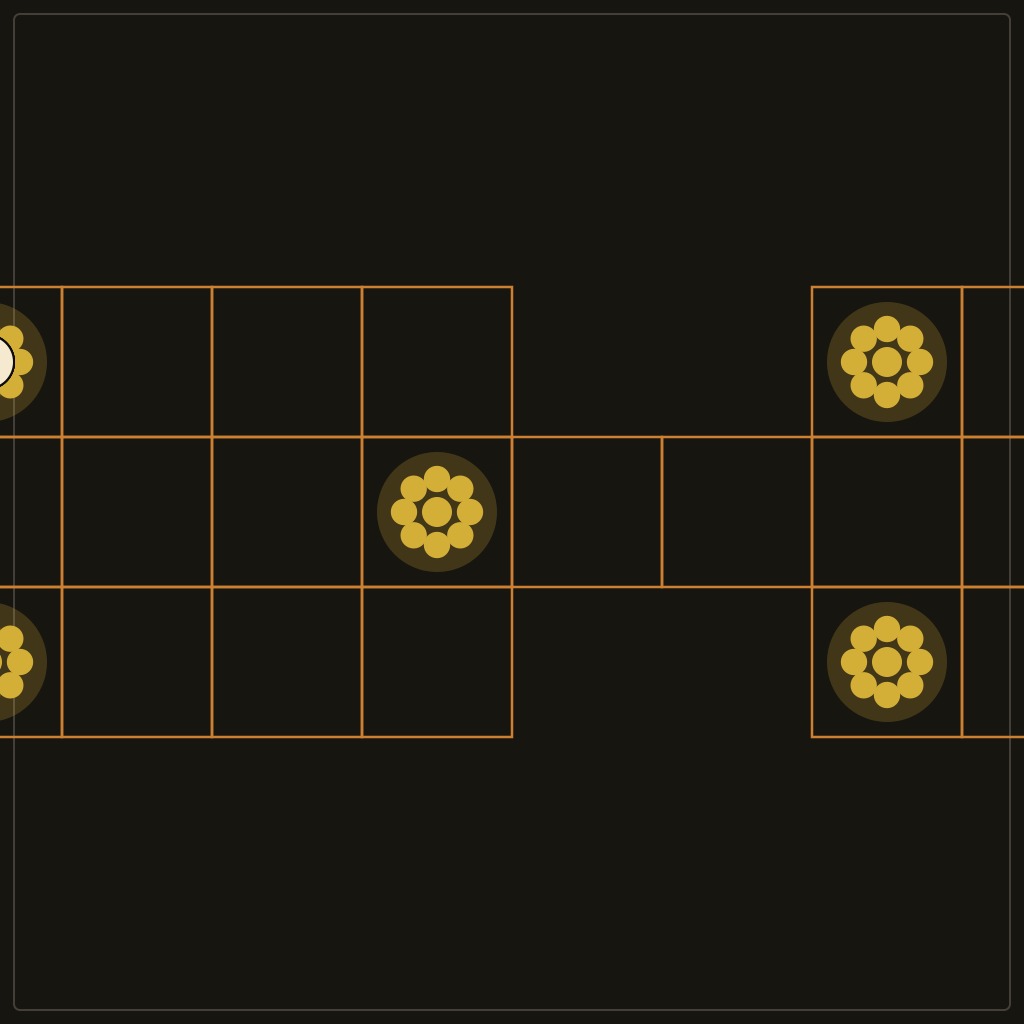
The board is unmistakable: twenty squares arranged in two blocks joined by a narrow bridge, five of them marked with five-pointed rosettes. Alongside the boards lay sets of small playing pieces and tetrahedral dice, the pyramidal four-sided dice that drove play. These were not idle curiosities. Such games were buried with the dead and scratched into palace doorways, which suggests a pastime woven deeply into Mesopotamian daily life.
A race across two millennia
The Royal Game of Ur is a race game, a contest to move one’s pieces along a track and off the board before an opponent does. It belongs to a long lineage. Over the centuries the design spread across the ancient Near East and changed, its layout straightening into the so-called Twenty Squares form, also called Aseb. Boards of this family have turned up from Egypt to Crete to Sri Lanka, and the game was played for well over two thousand years, a span that rivals chess or backgammon for sheer longevity.
For most of modern history, however, how it was actually played remained a mystery. The boards survived; the rules did not.
The tablet that cracked the code
The breakthrough came not in the field but in a museum drawer. A small Babylonian clay tablet, inscribed in cuneiform around the second century BC by a scribe named Itti-Marduk-balāṭu, had been excavated in Babylon and then sat largely unexamined in the British Museum for nearly a century. In the 1980s, the Museum’s curator and Assyriologist Irving Finkel recognized that this tablet described the movement of pieces across exactly such a board. Combining its text with the geometry of the surviving boards, Finkel reconstructed a plausible set of rules, the version most people play today.
That reconstruction sparked a revival. After Finkel demonstrated the game in a now-celebrated filmed match, the Royal Game of Ur found a large new audience online and in homes around the world. A game once sealed in a Sumerian tomb is again being played for fun, proof that the oldest amusements can also be among the most resilient.