Patolli · Rules
How to Play Patolli
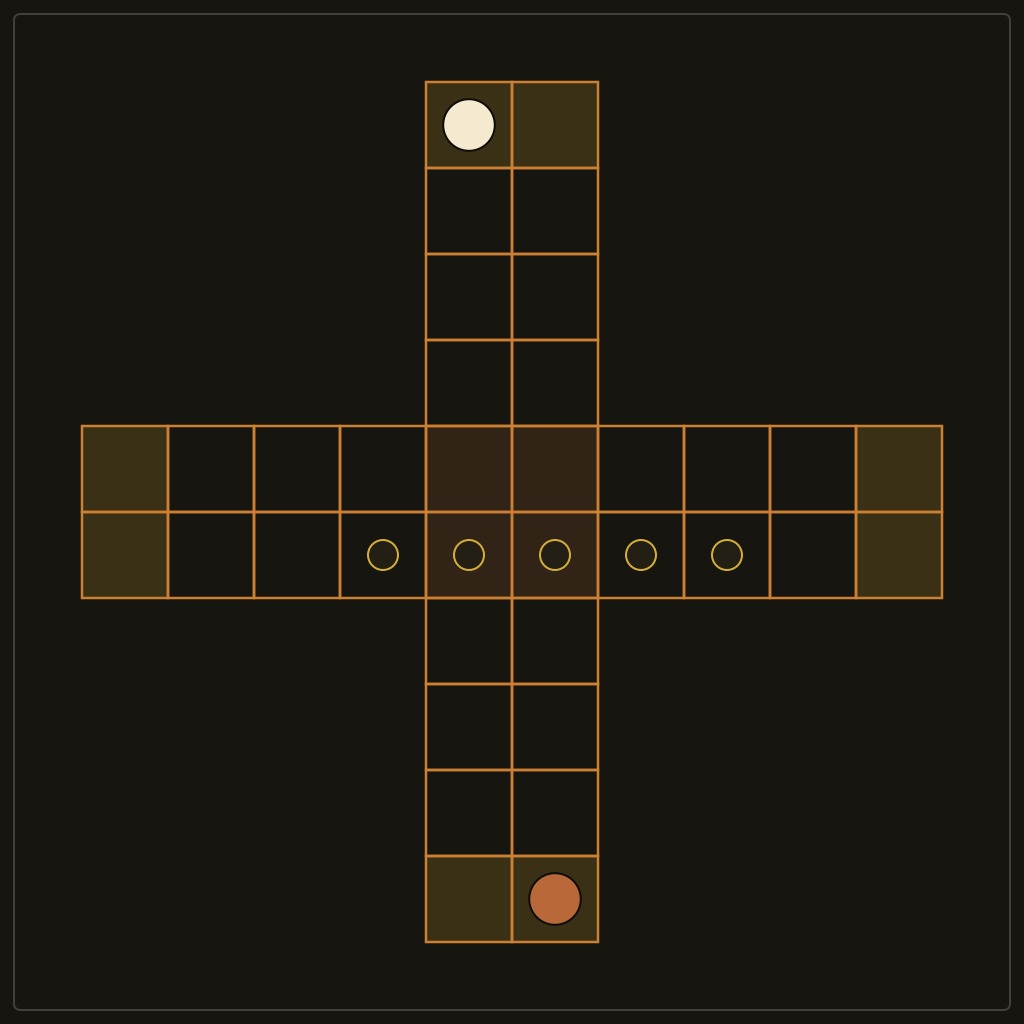
2-4 players · 30-60 min
Patolli is a fast, high-stakes race game from ancient Mesoamerica, combining a simple track with the thrill of gambling. Because the Spanish conquest destroyed nearly every board and mat, the rules below are a reconstruction, drawn from Spanish chronicles, surviving codices, and incised boards. Different sources reconstruct the details differently; the version here reflects the most widely accepted account.
The objective
Be the first player to move all of your pieces around the cross-shaped track, from your entry point through the full circuit and off the board, and, in doing so, win the pooled stakes that everyone has wagered.
Setup
The board is an X- or cross-shaped track, traditionally painted on a mat or leather. Each player takes six pieces of a single color, all of which begin off the board. Before play begins, each player places their wager into a common pool: blankets, beans, beads, or any agreed-upon goods. This staked treasure is the prize the winner will claim.
The bean dice
Movement is decided by five dried beans, each marked on one face (often by drilling a small hole). On your turn, you cast all five beans and count how many land marked-side up:
- 1 mark: move 1 space (and this throw lets you bring a new piece onto your starting square)
- 2 marks: move 2 spaces
- 3 marks: move 3 spaces
- 4 marks: move 4 spaces
- 0 marks (all blank): usually scored as the highest value, allowing a longer move
A throw of exactly 1 is special: it is the throw that lets you enter a new piece onto the board at your starting space.
Moving and betting
Players take turns casting the beans and advancing a single piece by the count. You may only enter a new piece with the appropriate throw, so early turns are often spent getting pieces onto the track. As pieces race around the cross, landing on a square occupied by an opponent usually sends that piece back to start, a setback that can swing both the race and the betting.
The gambling never stops. In the historical game, additional wagers were placed throughout, on individual throws, on captures, and on who would finish first, so the pool of stakes grew as the contest wore on.
Winning
The first player to run all six pieces the full length of the track and off the board wins the game and sweeps the entire pool of stakes that the players have set aside. In the spirit of the original, this is the moment the watching crowd would have erupted: in Patolli, the victor does not just finish first, but carries home everyone’s treasure.