Egyptian · History
The History of Mehen
- Period
- c. 3000-2300 BC
- Origin
- Ancient Egypt (Old Kingdom)
- Players
- 2-6
- Play time
- 15-30 min
- Difficulty
- Easy
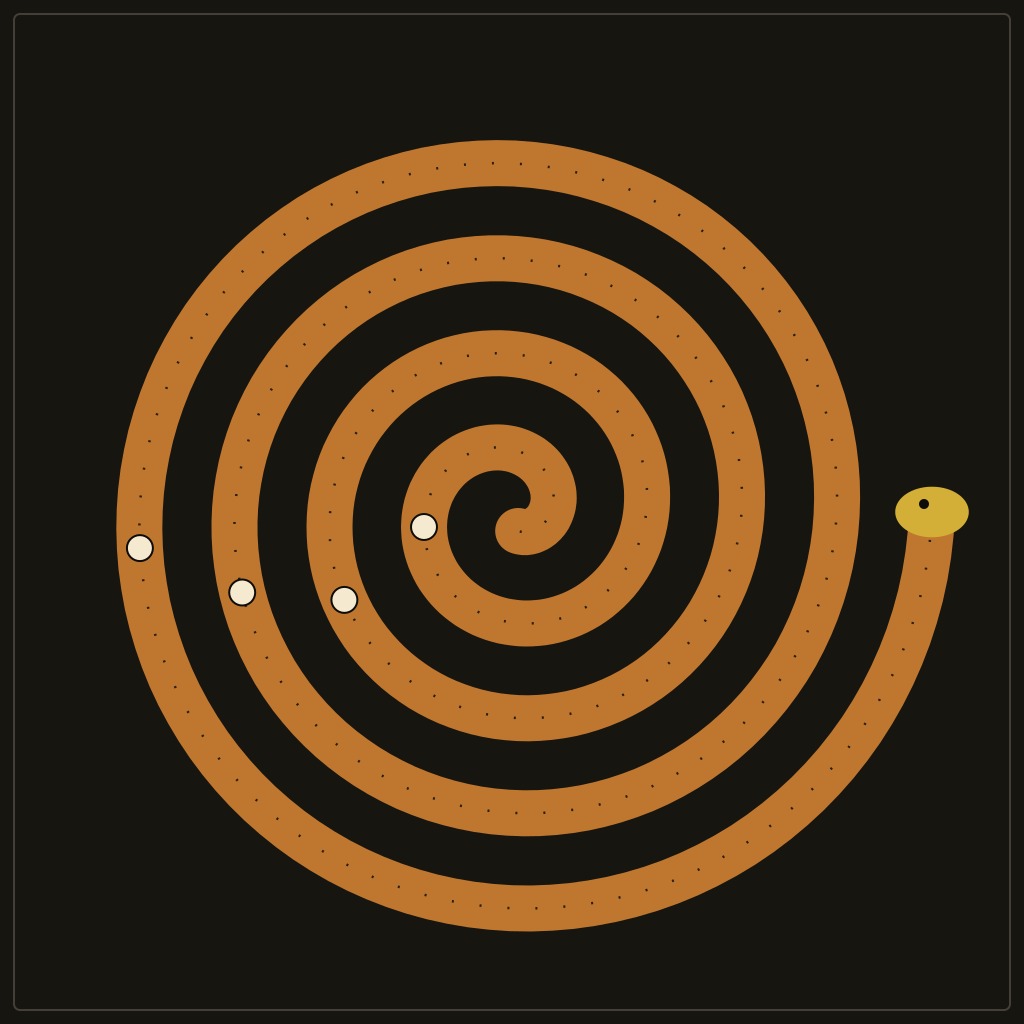
Among the oldest games humanity has left behind, few are as visually striking, or as mysterious, as Mehen. Its board is a serpent coiled upon itself, its body divided into a long spiral of segments running from the tail at the rim to the head at the center. Played in Egypt during the Old Kingdom, Mehen is one of the earliest known multiplayer board games in the world, seating as many as six players around a single coiled track.
A board in the shape of a god
Mehen takes its name from a deity of the same name, the protective serpent who, in Egyptian belief, coiled his body around the sun god Ra to shield him as he sailed through the dangerous hours of night. The name itself means roughly “the Coiled One,” and the board makes that mythology literal: the snake spirals inward in a tight whorl of playing segments, the count of which varied widely from one board to the next, some bearing a few dozen divisions, others well over a hundred.
This was not a board produced to a fixed standard. Each was carved by hand, and the variation in the number of segments suggests the game traveled by custom and memory rather than by any written rulebook. What unites them all is the form: the body of a god, made as a playing surface, with the journey toward the center echoing Ra’s nightly voyage toward rebirth at dawn.
Lions, lionesses, and marbles
Much of our evidence comes from the tomb of Hesy-Ra, a high official of the Third Dynasty (around 2650 BC), where a painted scene depicts a Mehen board alongside its equipment. From this and other finds we know the game was played with two kinds of carved animal tokens, lions and lionesses, together with sets of small marbles in differing colors. A typical assemblage included three lions, three lionesses, and several sets of six marbles, a count that points to a game built for multiple players rather than a simple duel of two.
Gaming pieces and serpent boards have been recovered from Egyptian tombs, where they were buried among the goods meant to serve the dead in the afterlife, a sign that Mehen was valued enough to accompany its owners beyond the grave.
A game lost to time
For all that survives, the rules of Mehen are largely lost. No ancient text sets out how the lions, lionesses, and marbles moved across the coil, and scholars must reconstruct the play from the boards, the pieces, and the few tomb images that show the game in use. The common view holds that it was a race game, with tokens traveling along the spiral from the tail toward the head at the center, but the particulars of capture, turn order, and the roles of the different pieces remain matters of informed conjecture.
Stranger still, Mehen vanished from the record near the close of the Old Kingdom, around 2300 BC, fading from Egyptian life as quietly as it had appeared. It left behind only its serpent boards and a name borrowed from a god: a coiled puzzle at the dawn of the board game.