Roman · History
The History of Ludus Latrunculorum
- Period
- c. 1st century BC-4th century AD
- Origin
- Roman Empire
- Players
- 2
- Play time
- 20-40 min
- Difficulty
- Hard
Across the forts, taverns, and forums of the Roman world, two players hunched over a gridded board, moving rows of glass counters as though commanding armies in miniature. They called it Ludus Latrunculorum, the “game of little soldiers,” from latrunculi, the diminutive of latrones, meaning mercenaries or raiders. To play was to wage a small and bloodless war, and the Romans took it seriously.
A game of soldiers
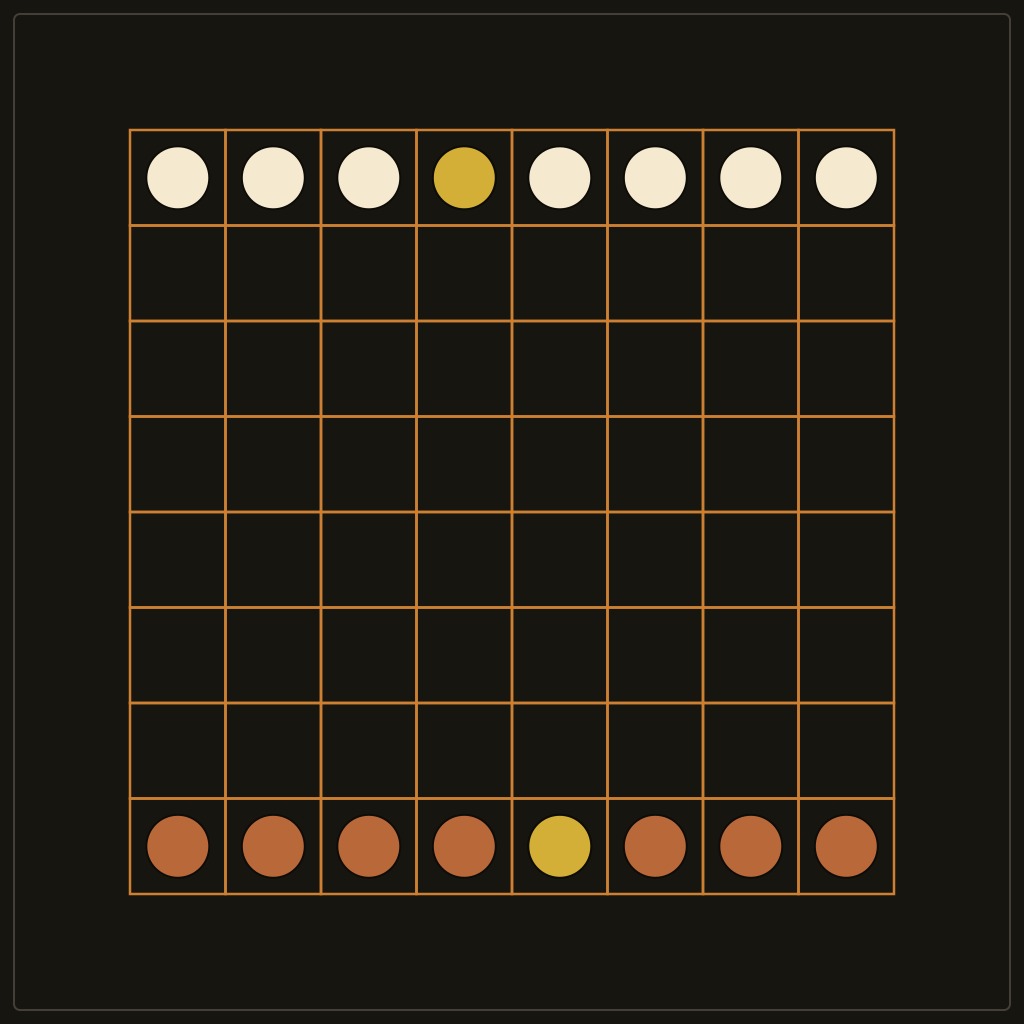
Ludus Latrunculorum was a two-player game of pure strategy, free of dice or chance. Each side fielded a band of pieces, typically made in black and white glass or stone, arrayed on a rectangular grid of squares. Boards have been excavated in many sizes, from 7×8 up to 8×8 and beyond, scratched into paving stones, gaming tables, and roof tiles wherever Romans gathered.
The game almost certainly descended from the earlier Greek game of Petteia, a “pebble game” of besieging and surrounding enemy pieces that the Greeks themselves traced back to mythic antiquity. The Romans adopted its central idea, the custodial capture, in which a piece caught between two enemies is taken, and gave it a military flavor, recasting the counters as soldiers and the board as a field of war.
Praised by poets and played by legions
The game’s reputation appears throughout Roman literature. The scholar Varro (116 to 27 BC) referenced its gridded board in his De Lingua Latina, comparing its lines to a grammatical table. Ovid recommended skill at the game as an attractive social grace in his Ars Amatoria and described its method of capture by enclosure. The 1st-century AD panegyric Laus Pisonis praised its subject’s mastery of the board, describing how “wars are fought out by a soldiery of glass,” with a white counter trapping blacks and a black counter trapping whites.
This was not only an aristocratic pastime. The game traveled with the legions to the frontiers of the Empire, and its boards turn up carved into the stones of military forts from Britain to the Danube. For soldiers waiting out long postings, latrunculi offered a contest of cunning that mirrored their trade.
What we know and what we don’t
For all its popularity, no complete ancient rulebook for Ludus Latrunculorum survives. The Romans, who recorded so much, never set down a full account of how the game was played. What we possess are scattered literary hints, the evidence of excavated boards, and references to capture by enclosure. As a result, the rules of latrunculi are reconstructed: modern interpretations built from these fragments rather than a faithful transcription of an ancient text. Several plausible rulesets exist, and the version most commonly played today is itself an informed reconstruction. We play, in a sense, an echo of a game the Romans loved but never fully explained.