April 13, 2026
Mehen: The Egyptian Serpent Game Lost to Time
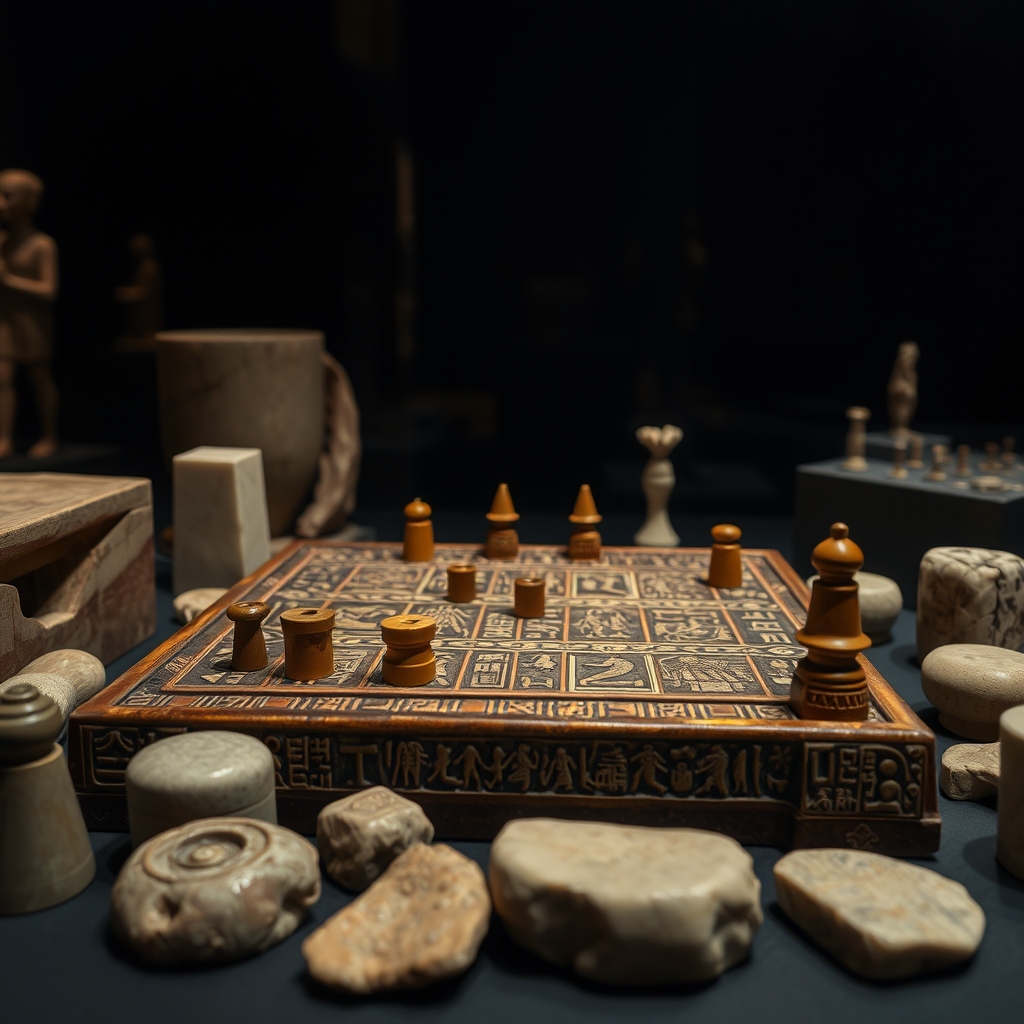
Among the oldest objects ever recognized as a game, the board for Mehen does not look like a battlefield or a racetrack. It looks like a snake. Carved in stone and coiled in upon itself, its body is divided into a long spiral of segmented squares running from the tail at the rim to the head at the center. To the ancient Egyptians who played it more than four and a half thousand years ago, that spiral was not decoration. It was a god.
A god coiled around the sun
The game takes its name from Mehen, the protective serpent deity who wrapped himself around the boat of the sun god Ra each night. As Ra journeyed through the underworld, Mehen shielded him from Apophis, the great serpent of chaos who sought to devour the sun before dawn. The board reproduces that protective coil in miniature. To move a piece inward along the spiral was, in some sense, to retrace the nightly voyage toward rebirth.
The Pyramid Texts, the funerary inscriptions carved into Old Kingdom royal tombs, hint that this symbolism ran deeper than play. Some passages suggest a belief that reaching the center of the Mehen board mirrored the soul’s safe passage through the night and its joining of Ra on his solar barque. A game, in other words, that rehearsed the journey to the afterlife.
Archaeologists have recovered dozens of Mehen boards from contexts spanning roughly the 1st through 6th Dynasties, from before 3000 BCE to around 2200 BCE. The great majority belong to the early Old Kingdom, the age of the first great pyramids. For the elite buried with these boards, the serpent was a fitting companion for eternity.
How was it played?
Here the trail goes cold. No surviving text sets out the rules of Mehen in full, and so reconstructions rest on the surviving equipment and careful inference. Gaming sets associated with Mehen boards typically include carved lions and lionesses, often three of each, alongside collections of small marble-like spheres, usually six sets of six. Recent scholarship suggests the marbles were both moved along the coiled track and used in a guessing or casting process to determine movement, so that chance and choice both shaped the race toward the center.
Beyond that, much remains uncertain. We do not know precisely how the lions interacted with the marbles, or what victory looked like. What we can say is that Mehen was a multi-player game, unusually so for the ancient world, and that it was played and treasured across centuries by people who placed it in their tombs for the world to come.
The game that vanished
Then, almost as suddenly as it appeared, Mehen disappeared. By the end of the Old Kingdom it falls out of the archaeological record, displaced over time by Senet and other games that would endure for millennia. Why a game so widespread and so charged with religious meaning should simply vanish remains one of the quiet mysteries of Egyptian play. The serpent that guarded the sun could not, in the end, guard itself from oblivion.
What survives are the boards themselves: silent spirals in museum cases, their rules half-guessed, their meaning still legible in stone. To hold a faithful reproduction of one is to feel the weight of that lost world in your hands, to trace with a fingertip the coil that an Egyptian player traced before the pyramids were old.
If you would like to bring that ancient coil back to the table, explore our reconstruction of Mehen and let the serpent guide your play toward the center once more.