March 16, 2026
Mancala: Africa's Ancient Game of Counting and Capture
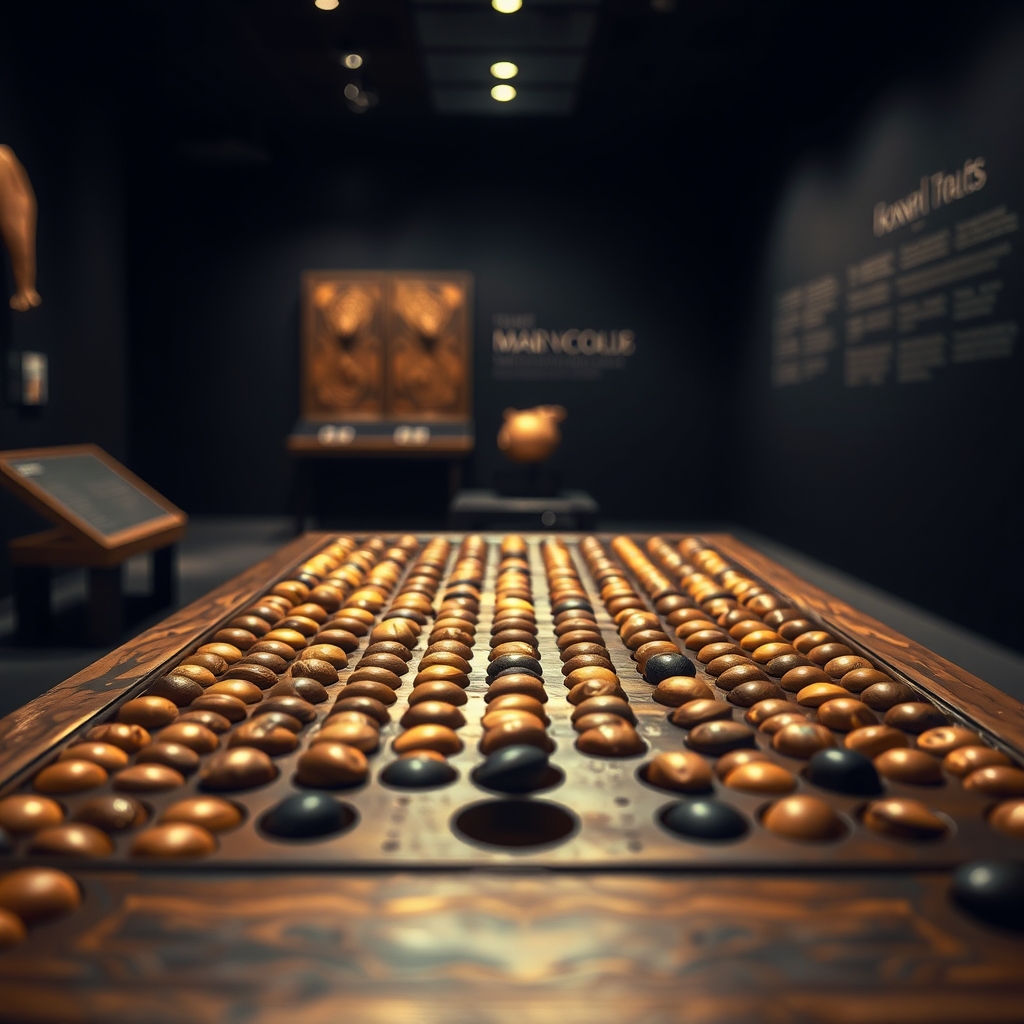
Mancala is less a single game than an entire family, a large tradition of “sowing” games that share one idea: you pick up a handful of seeds and drop them, one by one, into the pits around the board. From that simple gesture comes a world of strategy, and a history that stretches across Africa, the Middle East, and Asia for well over a thousand years.
A game sown across continents
The word “mancala” comes from the Arabic naqala, meaning “to move,” and it covers hundreds of regional variants: oware in West Africa, bao along the Swahili coast, and many more. The archaeological trail is long, if sometimes hard to date precisely. Fragments of pottery boards and rock-cut pits found in a Roman-era bathhouse at Gedera have been dated to the 2nd or 3rd century CE, and boards from Aksumite sites at Matara in Eritrea and Yeha in Ethiopia fall somewhere around the 6th to 7th centuries CE. Rows of pits worn into the roofing stones of Egyptian temples have long been pointed to as possible boards, though they are very difficult to date and may have been cut long after the temples themselves were raised.
What is certain is that the game spread along the great trade routes, carried by merchants and travelers until it had taken root across half the globe. Few human pastimes have proven so portable or so persistent.
The mechanics of sowing
The appeal of Mancala is in how physical it is. A typical board has two rows of pits, with a larger store at each end. On your turn you scoop up all the seeds from one of your pits and “sow” them, dropping one into each pit as you move around the board. Land your last seed just right, in your own store, or beside a vulnerable group of your opponent’s pieces, and you capture. The player who gathers the most seeds wins.
It is a game of counting before it is a game of conflict. Children learn arithmetic through it almost by accident, tracking how many seeds will land where. Skilled players think several sowings ahead, setting up chains of captures and starving an opponent of the seeds they need to move. The rhythm of the game, the click of pieces dropping into pit after pit, is part of its appeal.
Why it lasts
Mancala has survived because it asks so little and offers so much. The board can be carved into wood, molded from clay, or simply scooped into the earth, and the pieces can be seeds, pebbles, shells, or beads. There are no cards to lose, no batteries to fail, no language barrier to the rules. This is a game that a grandparent and a grandchild can share without a single word of instruction once the first round is played.
That resilience is why it remains a living tradition rather than a museum curiosity. In countless homes today, the same sowing motion continues that was made in an Aksumite courtyard fifteen centuries ago.
To run your fingers through a row of polished seeds and sow them around a faithful board is to join one of the longest unbroken games in human history. Our Mancala set is made to honor that lineage and to keep it moving.