October 12, 2026
Liubo and the Lost Games of Ancient China
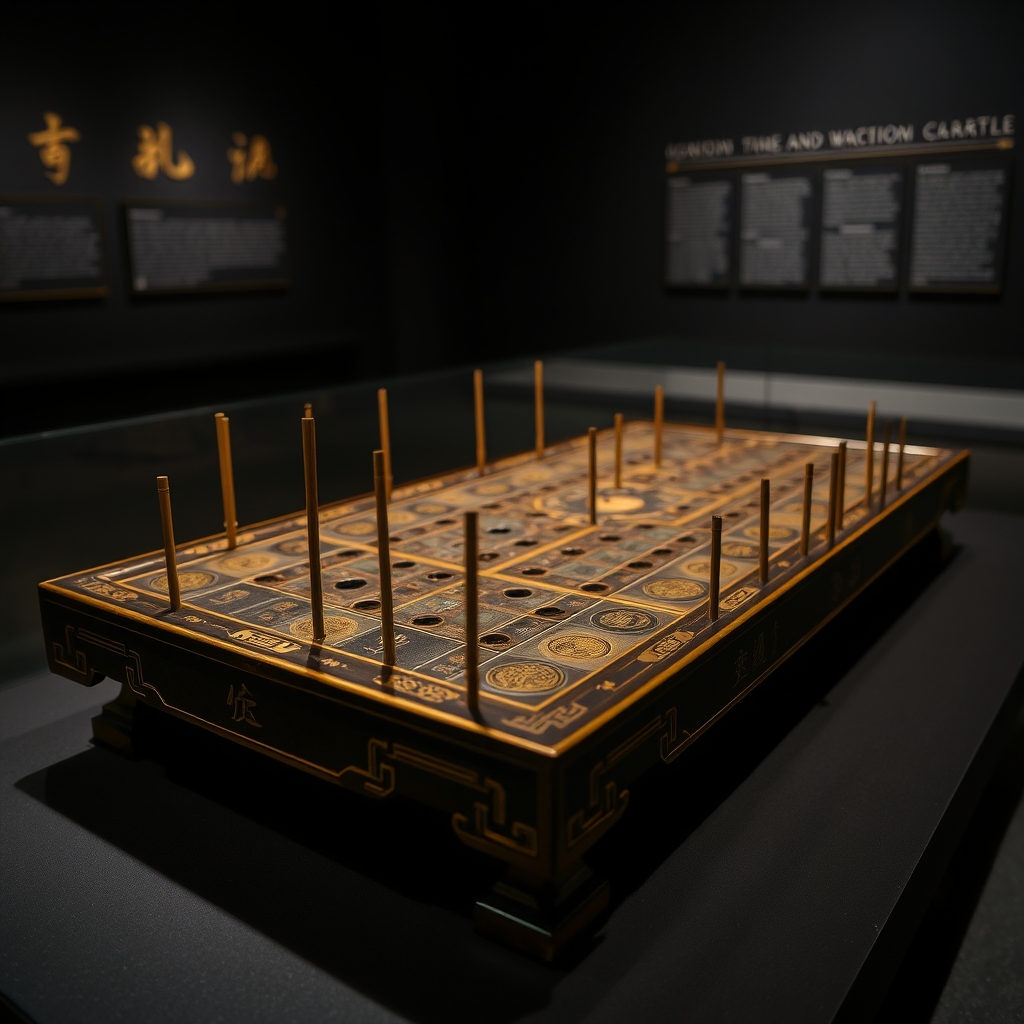
For some four centuries, liubo was the prestige game of China. Emperors played it; poets praised it; tomb murals and bronze figurines preserved players frozen mid-throw; and the gods themselves were imagined hunched over its board. Then, around the seventh century, it vanished so thoroughly that today no one can say with confidence how it was actually played. Liubo is the great enigma of ancient gaming, abundantly documented and yet fundamentally lost.
The board and its cosmos
A liubo set was an object of status. In its finest form the board was lacquered wood inlaid with mother-of-pearl, and across its surface ran a distinctive geometric pattern that modern archaeologists call the TLV design, after the shapes of its incised marks: T-shapes at the midpoint of each side, L-shapes near the corners, and V-shapes at the corners themselves. The same pattern appears on the bronze “TLV mirrors” of the Han period and on Han cosmic diagrams, where a central square stands for the earth and the surrounding field for the heavens. The board, in other words, was a map of the ordered universe, and to play across it was to move through a model of the cosmos.
The game was played by two opponents who cast throwing sticks to determine their moves and advanced counters across this charged surface. One scholarly reconstruction suggests a counter began on an L-mark and worked toward a V-corner, with certain throws letting a piece enter the center to “kill” an opponent already resting there. But this remains conjecture. By the late Tang dynasty no one was playing liubo, and no one who still understood the rules had thought to write them down. We are left with the equipment and almost none of the instructions.
Players among the immortals
What survives most vividly is liubo’s association with the divine. Han mythology placed the game in the hands of immortals: the sage Dongfang Shuo was described playing liubo with deities, and the game was imagined as a medium through which mortals and immortals might communicate. A second-century bronze mirror from Shaoxing, in Zhejiang province, shows four supernatural figures seated around a square board bearing the TLV design, a snapshot of the gods at play. To the Han mind, the board’s cosmic geometry made it a fitting meeting ground between worlds.
This is part of why liubo’s disappearance is so striking. A game woven into both imperial prestige and religious imagination might seem unlosable. Yet the same forces that buried other ancient games, namely shifting fashion, broken chains of teaching, and the rise of newer pastimes, overtook it all the same. As liubo faded, games like weiqi (Go) and, later, Chinese chess rose to take its place at the cultured table.
The allure of the unsolved
There is a particular fascination in a game we can hold but cannot fully play. The TLV board is real, tangible, and beautiful; its rules hover just out of reach, the subject of ongoing scholarship and informed reconstruction. Liubo reminds us how much of the ancient world reaches us as a riddle rather than an answer.
If the lost games of antiquity intrigue you, explore our growing collection of reconstructed ancient boards and consider the patient detective work that lets a game speak again after fifteen centuries of silence.