June 15, 2026
Fidchell and Gwyddbwyll: The Board Games of the Celts
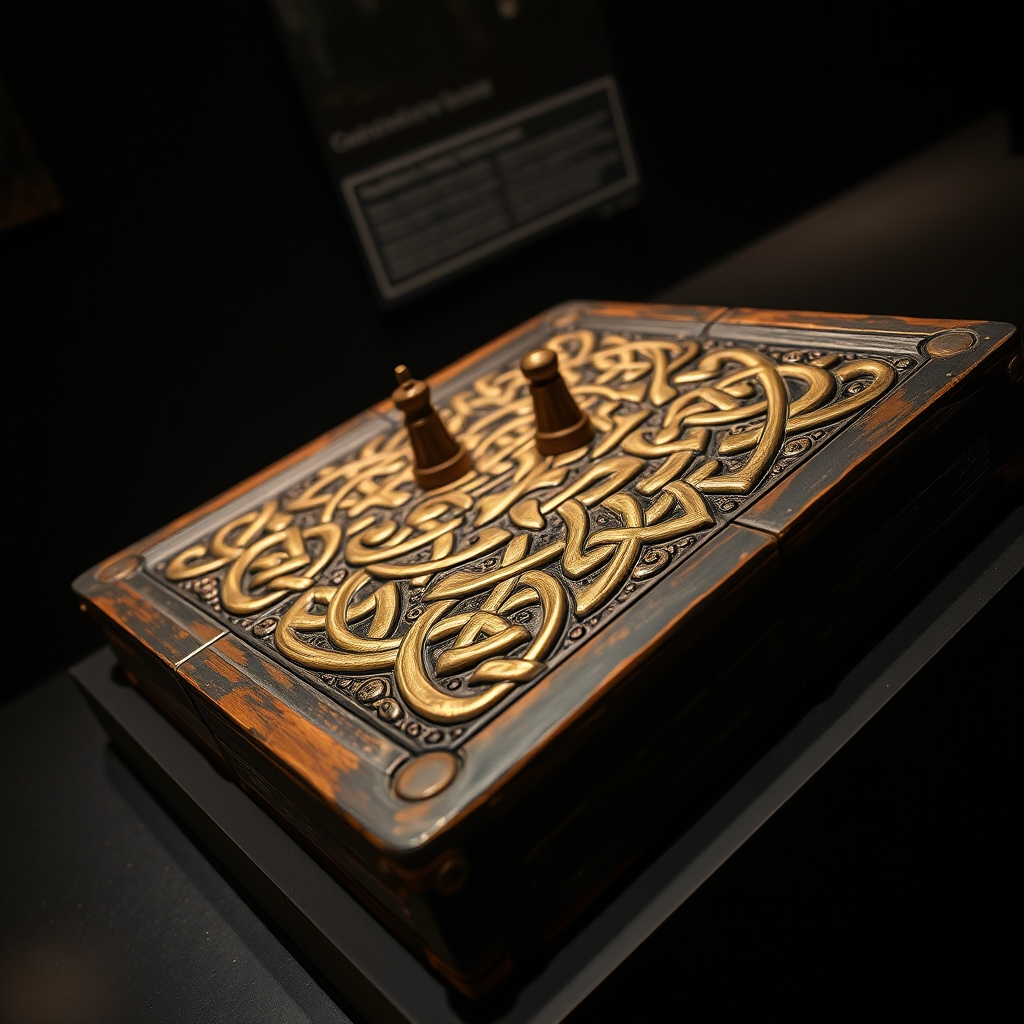
In the literature of the early Celts, a board game appears at the elbow of every hero. Cú Chulainn plays it; King Arthur plays it; gods are said to have invented it. The Irish called it fidchell; the Welsh, gwyddbwyll. The names are nearly identical compounds, something close to “wood-wisdom” or “wood-sense,” and that the two languages share the word almost exactly is itself a clue. The game must be very old, older than the split between the Irish and British branches of the Celtic tongue.
A game woven through myth
Few ancient games are so well attested in story and so thinly attested in dirt. Gwyddbwyll runs through the Welsh Mabinogion, where it is played with golden men on a silver board. In one famous tale, Arthur and Owain play game after game while messengers arrive to report a battle raging between Arthur’s men and Owain’s magical ravens, the contest on the board mirroring the contest on the field. Irish legend credits the invention of fidchell to Lugh, the god of light and craft, and places the board in the hands of his descendant Cú Chulainn, the Ulster Cycle’s greatest warrior.
To the Celts, then, fidchell was not idle amusement. It was a kingly accomplishment, a test of the strategic mind expected of any noble or hero, and it carried an aura of the sacred.
What the game actually was
Here the historian must speak carefully. No complete set of rules survives. What we have are literary descriptions and scattered archaeological finds of pieces and pegged boards across Ireland and Britain. From these, most scholars conclude that fidchell and gwyddbwyll were not chess, since chess did not reach Europe until the 12th century, but belonged to the older family of “war games” related to the Roman ludus latrunculorum, in which two players maneuvered equal forces to surround and capture.
Likely it was a relative of the later Norse tafl games, in which an asymmetric battle plays out on a gridded board. Fidchell appears to have been gradually displaced by tafl during the Viking Age, as Norse settlers brought their own pastime to Celtic shores. The reverence attached to fidchell, however, never quite faded from the stories.
Playing with legend in your hands
Reproducing a Celtic board game is an act of careful inference rather than pure copying, and we treat it that way, drawing on the surviving pegged boards and the war-game logic the literature implies. The result is a game that lets you sit where Lugh’s heir was imagined to sit, moving wooden men in a contest of nerve and foresight while, somewhere offstage, ravens gather.
If the myths of Ireland and Wales stir something in you, explore the Celtic games and their cousins across the full catalog. The board the bards sang about is waiting to be set.