June 8, 2026
The Board Games of Ancient Mesopotamia
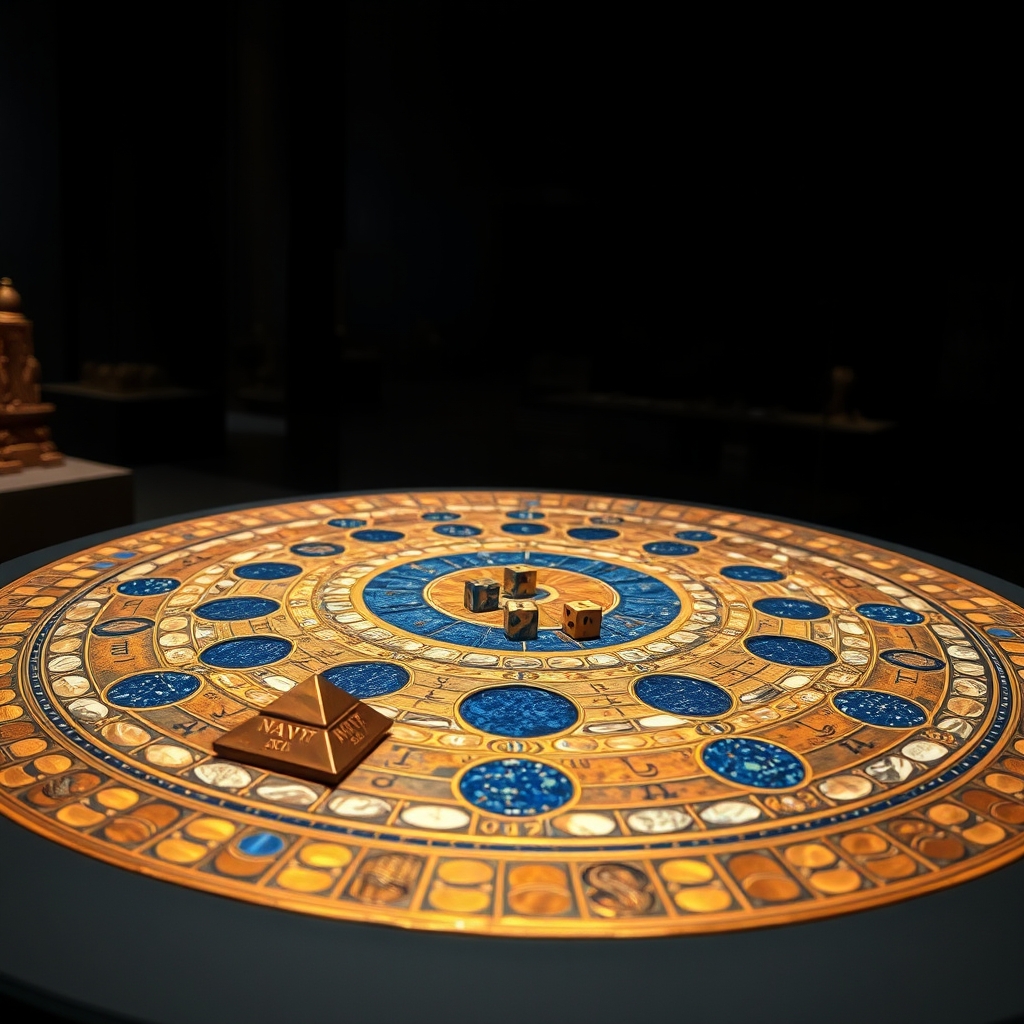
Between the Tigris and the Euphrates, the people who invented the wheel, the city, and writing also found time to invent games, and to take them seriously enough to bury them with their dead. Mesopotamia is, by the evidence we have, the cradle both of civilization and of organized play. To understand the ancient board game is to begin here, in the dust of cities four and five thousand years old.
The game that came out of the royal tombs
The most celebrated discovery belongs to Sir Leonard Woolley, who between 1922 and 1934 excavated the Royal Cemetery at Ur in southern Iraq and lifted five inlaid gameboards from the graves. These boards, dating to roughly 2600 to 2400 BCE, gave their name to the Royal Game of Ur. The design is unmistakable: two blocks of squares, one of twelve and one of six, joined by a bridge, the whole surface glittering with shell, lapis lazuli, and red limestone.
It is a race game for two players, each commanding seven pieces, with movement decided by four tetrahedral dice read by counting the marked corners that land facing up. For decades its rules were lost. Then Irving Finkel of the British Museum recognized a cuneiform tablet, written by the scribe Itti-Marduk-balāṭu around 177 BCE, as a description of how the game was played. The reconstruction has held up well, and the game it yields is good: tense, quick, and built on the gambler’s hope of landing on a protected square.
A game that crossed an empire
The Royal Game of Ur was no local curiosity. Archaeologists call its broader family the “Game of Twenty Squares,” and boards of this type turn up from Iran to the Levant, from the mid-third to the mid-first millennium BCE. It was scratched onto a guardian-bull statue at the gates of an Assyrian palace by bored sentries. It traveled to Egypt, where a twenty-square board frequently appears on the reverse of a Senet box. Few human pastimes have ever spread so far and lasted so long.
That endurance tells us something. A game survives across centuries and borders only when it satisfies a deep appetite, the pleasure of a contest in which skill and fortune are finely balanced, so that a child can win and a king can lose.
Why Mesopotamia still matters to players
The Mesopotamians left us more than rules. They left us the idea that a game is worth making beautiful, worth lapis and gold and a craftsman’s months, and worth carrying into the grave for use in another world. When you set out a faithful replica of the Royal Game of Ur, you are not merely playing an old game. You are repeating a gesture made by Sumerian nobles before the pyramids were built.
Our reproduction follows the surviving boards square for square, marker for marker. Explore the Royal Game of Ur, or browse the full catalog to see what else the ancient world has set out on the table for you.