January 12, 2026
The Board Games of Ancient Egypt
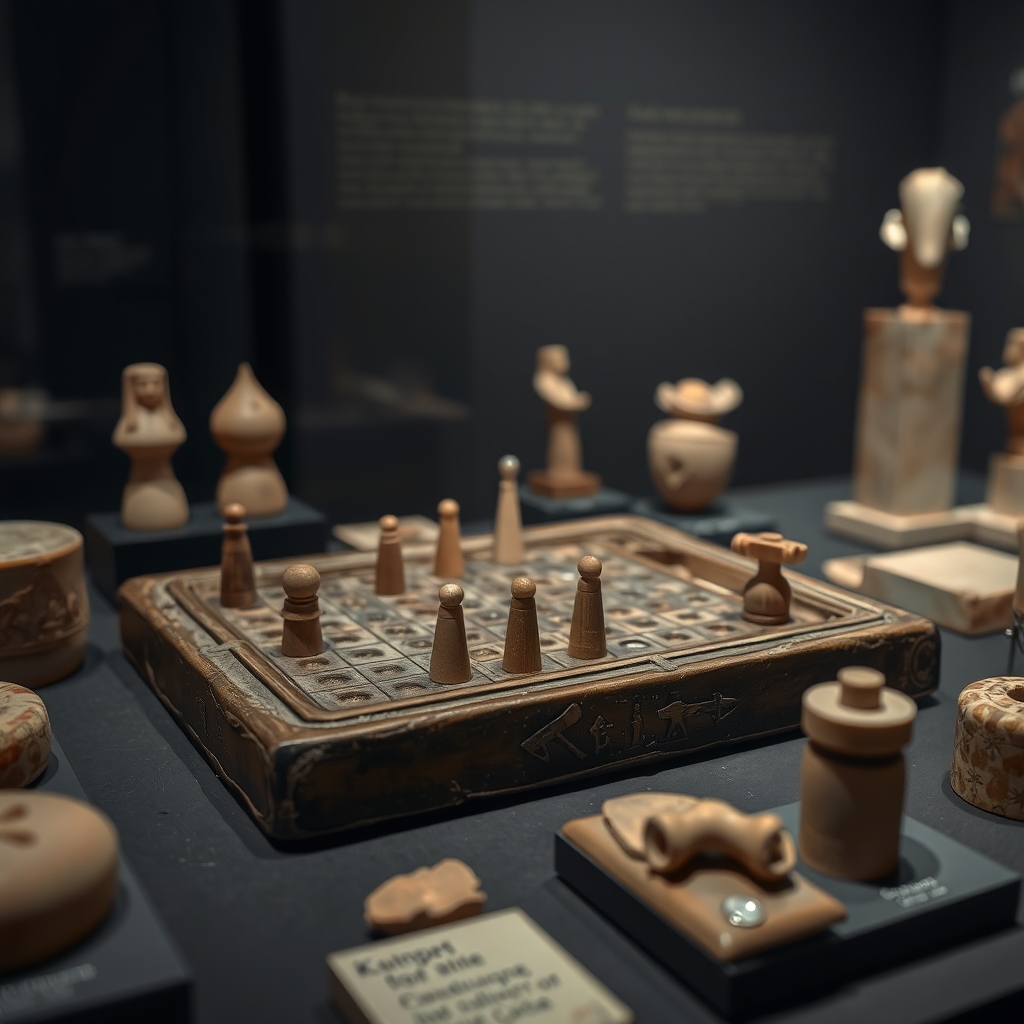
The civilization of the Nile gave us monumental architecture, a written language that lasted for millennia, and an elaborate vision of the afterlife. It also gave us some of the earliest board games ever recovered. For the Egyptians, play was not a frivolous diversion set apart from sacred life. Their games were buried in tombs, painted on walls, and woven into religious texts. To understand how Egyptians played is to glimpse how they thought about chance, the cosmos, and the journey after death.
Senet, the game of passing
The most celebrated Egyptian game is Senet, whose name means “passing.” Played on a board of thirty squares arranged in three rows of ten, it pitted two players in a race to move their pieces off the board, with movement determined by throwing casting sticks rather than rolling dice. Senet appears in the archaeological record as early as 3100 BCE, which makes it among the oldest known board games in the world.
What began as a pastime grew into something more. By the New Kingdom (roughly 1550 to 1070 BCE), Senet had become bound up with beliefs about the afterlife. Several squares near the end of the board were marked with symbols representing hazards the soul would face, and the game came to be understood as a rehearsal for the journey of the ka through the underworld. Scenes of the deceased playing Senet appear on tomb walls and in copies of the Book of the Dead. You can read more in our Senet history.
Mehen and the coiled serpent
Older even than Senet’s religious phase was Mehen, “the coiled one,” played during the Predynastic Period and the Old Kingdom (about 2649 to 2130 BCE). Its board took the form of a serpent coiled into a tight spiral, its body divided into segments that made up the playing track. The name referred to a protective deity who wrapped around the sun god Re during his dangerous nocturnal voyage.
Mehen was played with lion-shaped pieces and small marbles, though its exact rules are lost to us. What we do know is that its popularity declined sharply in the mid-third millennium BCE, and by the late Old Kingdom it had vanished entirely from Egyptian material culture, leaving behind only its carved boards.
Hounds and Jackals, a game of pegs
The third great Egyptian game carries a modern name. Hounds and Jackals was christened by the archaeologist Howard Carter, who recovered a complete set from a Theban tomb dating to the reign of Amenemhat IV in the 12th Dynasty. That set now resides in the Metropolitan Museum of Art.
The board was shaped like an axe-head or shield, pierced with fifty-eight holes arranged in two tracks, and the playing pieces were slender pegs topped with the carved heads of hounds and jackals. As players advanced their pegs, special links between certain holes could send a piece leaping forward or tumbling back. Holes marked with the hieroglyph nefer, meaning “good,” were beneficial, and the game ended when a player’s pieces reached the final hole, often encircled by a shen ring symbolizing eternity and protection.
Together, these three games reveal a culture that found in play a mirror of its deepest concerns: protection, fortune, and the passage from this world to the next. If you would like to bring one of these Nile-born games into your own home, browse our collection of faithfully crafted Egyptian replicas.